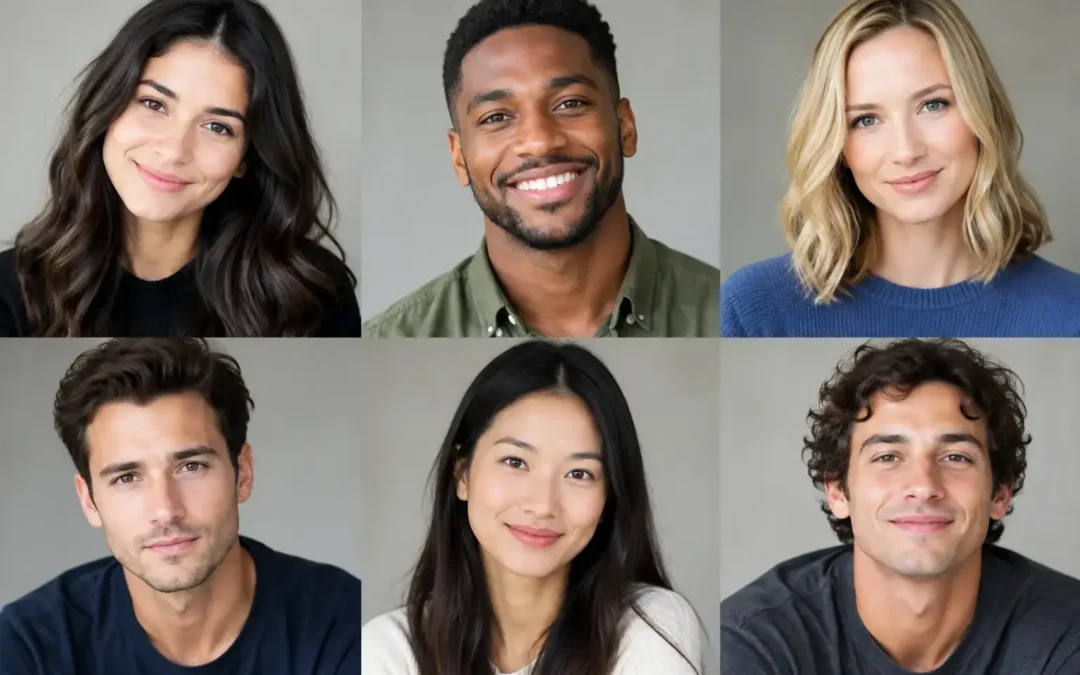
A casting director may spend only a few seconds deciding whether to open your Spotlight profile. Before they read your credits, they are reading your face. That is why casting headshot expression tips are less about producing a perfect smile and more about creating an immediate, believable sense of who you might be on screen or stage.
The strongest actor headshots do not look as though you are performing for the camera. They feel present, specific and alive. Your expression should leave room for a casting professional to imagine you in a role, rather than telling them exactly what to think.
Start with the casting brief, not a favourite expression
There is no single expression that works for every actor. A bright, open image might suit a performer often seen for commercials, comedy or approachable professional roles. A quieter expression can be far more useful for drama, authority or emotionally complex work. The aim is not to appear stern or cheerful on command. It is to understand the qualities your headshot needs to communicate.
Think in terms of casting energy rather than character types. You may want an image that feels warm, intelligent, grounded, watchful, mischievous or quietly assured. These are more useful starting points than trying to play “detective”, “mother” or “villain”. A good casting headshot should show your natural casting range without becoming a costume or a scene.
If you are unsure, look at the work you are genuinely drawn to and the roles for which you receive auditions. There may be a pattern in the way others already see you. Your headshot can work with that perception while still feeling like you on a good day.
Casting headshot expression tips: aim for thought, not posing
The most common issue in actor headshots is an expression that has been held for too long. The eyes go slightly fixed, the smile becomes mechanical, and the image starts to feel posed. It happens to experienced performers as well as those new to headshots, because being photographed can make anyone self-conscious.
Rather than trying to “look natural”, give your face something genuine to respond to. During a session, that might mean recalling a small moment that makes you laugh, thinking of someone you trust, or considering an idea that gives you a quiet sense of purpose. The thought does not need to be dramatic. In fact, simple is usually better.
A helpful distinction is between smiling and being amused. Between looking serious and being interested. A camera tends to notice the difference. When there is a real thought behind the expression, the eyes remain engaged and the face has subtle movement. That is where the connection happens.
Let your eyes do less, not more
Actors are often told that headshots need “life in the eyes”. That does not mean opening them wide or staring directly down the lens. Overworking the eyes can make an image look intense in an unhelpful way, particularly in a small online thumbnail.
Instead, allow your gaze to settle. Keep your focus just behind or into the lens as directed, breathe normally and resist the urge to force emotion. A relaxed face with attentive eyes is often more compelling than a highly charged look. Casting directors need to see you clearly, and they need to be able to project a role onto you.
Keep the mouth relaxed between frames
A tense jaw can change the whole mood of a portrait. It can make a friendly expression look guarded, or a thoughtful one look cross. Before each set of images, release your jaw, let your tongue rest naturally and take a slow breath out.
If you are aiming for a slight smile, let it arrive gradually rather than placing it on your face. A tiny lift at the corners of the mouth can be enough. You do not need to show teeth for an image to feel warm. Equally, a full smile can be exactly right when it reflects your real energy. It depends on your casting and the image you need.
Avoid giving the camera a finished performance
Your headshot is not a showreel still. It does not need to demonstrate sadness, menace, seduction or delight at full volume. Strong emotional choices often read as artificial when frozen in a single frame, especially when the viewer has no story to explain them.
This is particularly worth remembering if you have a naturally expressive face. Your instinct may be to give more, but a headshot usually benefits from restraint. Think of the expression as the moment before a line, when something is happening internally but has not yet been announced. That feeling of possibility is useful in a casting image.
There are exceptions. A sharply comic performer may need a bolder, playful image; someone with a distinctive screen presence may need to honour it rather than flatten it. Even then, the expression should remain recognisably yours. The best test is whether a person who knows you would say, “Yes, that is you,” rather than, “That is an interesting look.”
Build range through small shifts
You do not need a different face for every headshot. A well-planned session can create useful range through changes that are almost invisible: a softer gaze, a more direct connection, a gentler smile, a thoughtful pause or a slightly brighter energy.
These small shifts matter because casting professionals are highly attuned to faces. A subtle change can make one image feel suitable for an empathetic friend, while another feels right for a capable consultant, an ambitious lead or a character carrying a secret.
It is usually better to create two or three honest expressions than to chase ten exaggerated moods. For many actors, a welcoming image and a more neutral, connected image provide a strong foundation. If your casting is particularly broad, you may add a third look with a different wardrobe choice and energy. The key is that each image should still look like the same person.
Dress and grooming affect your expression more than you expect
Comfort shows on camera. If a collar is too tight, a jacket feels unfamiliar or your hair is constantly falling into place, your attention will be split. That tension often appears around the mouth, forehead and shoulders before you realise it is there.
Choose clothing that supports the intended casting feel without becoming a distraction. Solid colours and simple textures usually keep the focus where it belongs: on your face. Bring options, but do not treat wardrobe as fancy dress. A change of top can shift the tone of an image beautifully; it should not make you unrecognisable.
Hair and make-up should also feel like your most polished everyday self. Casting needs an honest representation of how you might arrive in a room. Heavy contouring, very glossy skin or styling that is hard to maintain can pull attention away from your expression and date the image quickly.
Use the session to settle, not to prove yourself
Many people expect to walk into a headshot session camera-ready, immediately confident and full of expressions. In reality, the first few minutes are often about getting used to the lights, the pace and the unusual experience of being watched through a lens. That is entirely normal.
Give yourself permission to warm up. A specialist actor headshot photographer will guide you, make adjustments and notice when an expression is beginning to look effortful. Conversation is not a distraction from the photograph; it is often how the most natural expression appears.
At Henrietta Photography, the approach is relaxed but purposeful: creating enough ease for your personality to come through, while keeping a close eye on the fine details that make an image casting-ready. You should leave with photographs that feel polished, not over-produced.
Choose the image that invites a second look
When reviewing your final gallery, do not only choose the shot in which you think you look most conventionally attractive. Choose the one with connection. Does it feel current? Does it resemble you when you are at your most alert and comfortable? Does it give a casting director a clear, immediate impression without closing down the possibilities?
Ask a trusted agent, acting coach or industry-aware colleague for their view if you can. Friends and family may understandably choose the broadest smile or most flattering angle, while someone who understands casting can help you identify the image that best supports your professional next step.
A useful headshot does not have to shout. It simply needs to make someone pause, look again and imagine what you could bring to the part. Give the camera a real thought, a little breathing space and the confidence to be seen.