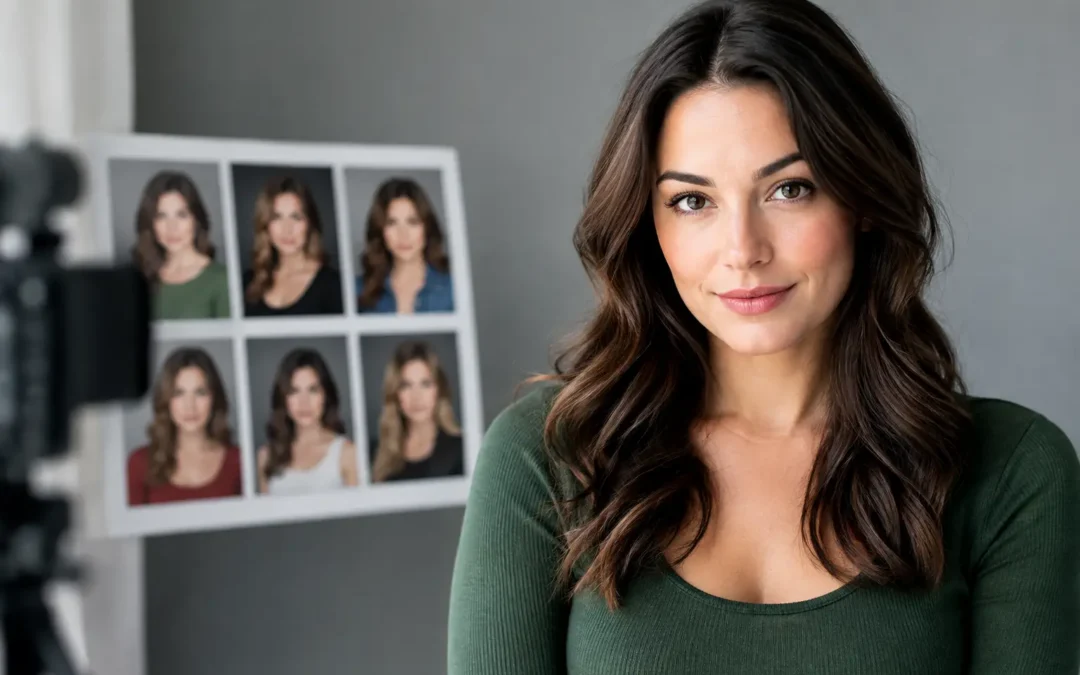
A casting director may look at your Spotlight profile for only a few seconds before deciding whether to open it further. In that moment, they need to see you clearly: your colouring, expression, age range and the truthful energy you could bring to a role. So, do actors need colour headshots? For most working actors, the practical answer is yes.
Colour is now the standard for professional acting headshots in the UK, particularly for Spotlight and online casting platforms. It gives casting teams a more immediate sense of how you look in real life, and it tends to reproduce more reliably across the phones, tablets and laptops where most submissions are viewed.
That does not mean black and white headshots have disappeared, nor that every colour image is automatically stronger. The best choice is always the photograph that feels recognisably like you, is beautifully lit and makes your casting type easy to understand.
Do actors need colour headshots for Spotlight?
In most cases, colour should be your principal headshot. Casting is increasingly fast, digital and visual. A clear colour portrait helps a casting director see the details that black and white naturally removes: the warmth or coolness of your complexion, hair colour, eye colour and the overall contrast of your features.
This matters because those details can inform a character brief. A production may be looking for a particular family resemblance, a period look, a believable sibling pairing or an actor who reads as a certain age and background at first glance. Colour is not a substitute for talent, of course, but it gives the person viewing your profile more useful information without asking them to guess.
A current colour headshot also tends to feel more aligned with the rest of the casting process. Self-tapes are in colour. Video clips are in colour. Social and production imagery are in colour. Your headshot should provide an honest, confident first introduction that connects naturally with what the casting team will see next.
For this reason, it is sensible to lead with a colour image on your profile, especially if you are updating your materials or beginning to submit yourself regularly.
Why colour usually works better
A good acting headshot is not simply a flattering portrait. It is a casting tool. It needs to communicate you, rather than a heavily styled version of you, and colour can make that communication quicker.
Your eye colour may be a memorable feature. Your natural hair tone could affect how you are read for commercial work, television drama or a particular period project. Skin tone and facial contrast can alter the mood of an image too. When these things are shown accurately, a casting director can make a faster, more confident decision about whether you might fit the brief.
Colour also gives a photographer more subtle ways to shape a portrait. The right background, wardrobe shade and lighting can bring attention to your eyes without becoming distracting. Soft, natural-looking colour grading can keep skin looking healthy and polished, while still feeling true to life.
The key word is natural-looking. Your headshot should not leave anyone wondering whether it was taken five years ago, edited beyond recognition or based on a different version of your appearance. If you arrive at an audition with a different haircut, different hair colour or a noticeably different face from your profile photograph, you create unnecessary friction at precisely the point when you want to feel at ease.
When black and white headshots can still be useful
Black and white can be striking. It removes colour information and directs attention towards line, expression, light and character. For an actor with distinctive features or a particularly strong dramatic presence, a monochrome image may have real impact.
It can work well as a secondary option where your casting profile allows more than one image. A thoughtful black and white portrait might suit a theatre-focused submission, a more classical look or a role where mood is particularly relevant. It may also be a useful image for your personal website, printed portfolio or professional publicity materials.
However, it is rarely wise to rely on a black and white image alone. A beautiful monochrome portrait can be compelling, but it provides less immediate visual information than colour. It may also look less current beside a set of colour submissions. If you love black and white, the best compromise is usually to choose a strong colour headshot first, then include one monochrome image only if it adds something genuinely different.
Avoid treating a black and white conversion as a way to rescue a photograph that is not working in colour. If the expression is guarded, the lighting unflattering or the likeness inaccurate, removing the colour will not solve the underlying issue.
What casting teams notice before colour
Colour matters, but it is not the first thing that makes a headshot effective. A casting director is looking for clarity and connection. They want to know who is in front of them, how you might play and whether the person in the photograph feels present.
Your eyes should be easy to see. The expression should feel alive, not frozen into a broad smile or an attempt at seriousness. There should be enough space around your face for the image to read clearly as a thumbnail, but not so much that your face becomes small within the frame.
A good actor’s headshot also has a sense of specificity. It should not attempt to show every possible side of you in one image. Instead, it should capture a truthful, usable casting energy: warm and open, intelligent and grounded, mischievous, authoritative, vulnerable, polished or quietly intense. Those qualities come from collaboration, good direction and the confidence to be yourself in front of the camera.
That is why an experienced portrait photographer will spend time helping you settle, adjusting small details and looking for the expressions between the posed moments. The right photograph often arrives just after you stop trying too hard.
Choosing wardrobe and background for colour headshots
For colour headshots, simple choices are usually the strongest. Wear clothes that feel like you and sit comfortably within the kind of roles you are likely to be seen for. A plain top or a subtle texture often photographs better than loud logos, busy prints or very trend-led styling.
Choose colours that flatter your complexion and do not compete with your face. This does not mean everyone should wear black. Navy, charcoal, deep green, soft blue, burgundy, cream or muted earth tones can all work beautifully, depending on your colouring. Bring a small selection to the session if you are unsure, so you and your photographer can see what works best under the lights.
The background should support the portrait rather than become its subject. Neutral, softly coloured backgrounds are popular because they keep attention on the actor and work across a wide range of casting briefs. A clean background also helps when your image is viewed small on a casting platform.
Hair and make-up should look like an excellent version of your everyday self. You may wish to have your make-up professionally done, particularly if it helps you feel confident, but the aim is not a red-carpet transformation. Casting needs to recognise you when you walk into the room or appear on a self-tape.
Keep your headshot current, not merely polished
The more successful your headshot is, the more important it is to update it when your appearance changes. A new haircut, a significant shift in weight, facial hair, a change of hair colour or simply a few years passing can all be good reasons to book again.
There is no fixed timetable that suits every actor. Some people need new photographs annually because their work, look or casting range changes quickly. Others can use a strong image for longer. The useful test is simple: if someone who has not seen you recently would be surprised when you walked into the audition room, it is time for a new headshot.
It is also worth reviewing your images after a period of training, theatre work or screen experience. As your confidence and understanding of your casting start to develop, your headshots can become more precise. The goal is not to narrow your opportunities. It is to make it easier for the right opportunities to find you.
A colour headshot should still look like you
The question is not really colour versus black and white. It is whether your image makes a casting director pause for the right reasons. For most actors, a current, well-lit colour headshot is the most versatile and useful starting point, with black and white available as an optional second choice.
At Henrietta Photography, the focus of an actor headshot session is on creating relaxed, casting-ready portraits that feel polished without losing your individuality. Bring the version of yourself you would want a casting director to meet, and let the photograph do its clear, quiet work.