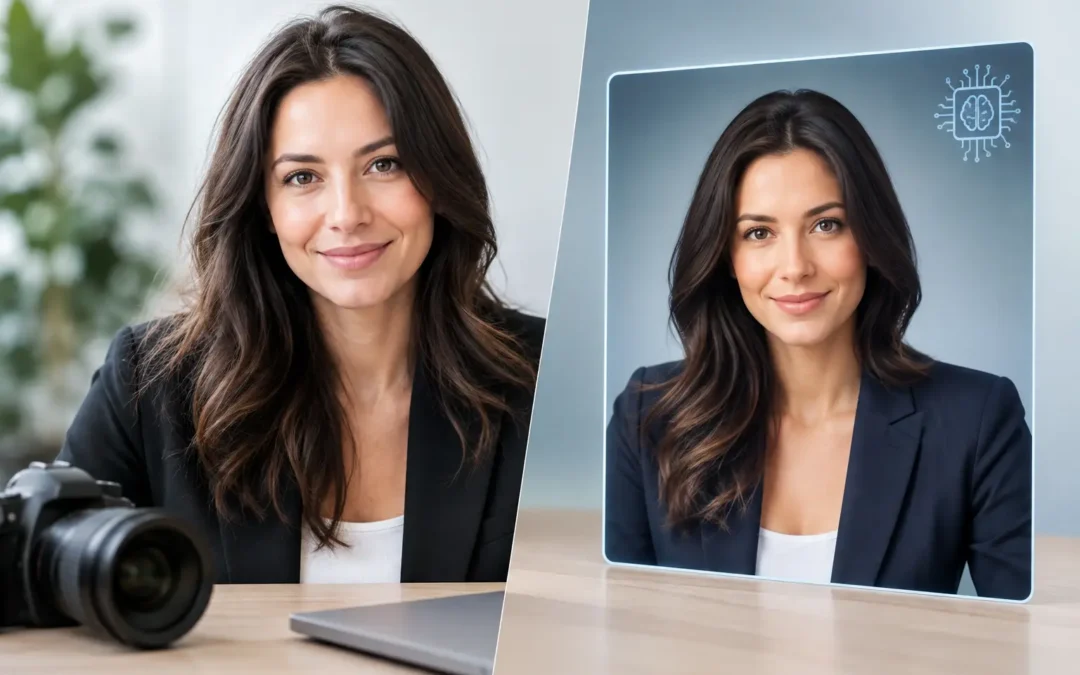
A LinkedIn profile photo can decide whether someone clicks through to your work. A casting director may look at a Spotlight headshot for only a moment before moving on. That makes the choice between professional photos versus AI headshots more than a question of convenience: it is a question of whether your image gives people the right first impression.
AI headshot tools promise polished portraits in minutes, often for less than the cost of a coffee. For some uses, that speed has a place. But a headshot is not simply a tidy image of a face. It needs to communicate confidence, character, credibility and, crucially, a recognisable version of you. The right option depends on where the photograph will be seen and what you need it to do.
Professional photos versus AI headshots: what is actually different?
A professional headshot is made with you, not generated around you. Your photographer considers the light, lens, background, clothing, posture and expression in real time. More importantly, they notice the small things that can make a portrait feel either stiff or engaging: a tense jaw, a dropped shoulder, a genuine smile arriving a second after the posed one.
AI headshots work differently. You upload a selection of selfies or existing photos, then choose from generated versions in various outfits, locations and styles. The software uses patterns from those images to create a new portrait. The result may look impressively polished at first glance, but it is an interpretation rather than a record of a real moment.
That distinction matters. A good professional portrait does not just make you look your best; it makes you look like yourself on a particularly good, well-rested day. An AI image can sometimes drift towards a more generic, idealised version of you, with unusually smooth skin, altered facial proportions or an expression you would never naturally make.
The case for AI headshots
AI has obvious appeal when time and budget are tight. If you need a temporary image for an internal company directory, a speaking engagement page or a new social profile, an AI headshot may give you something clean and presentable very quickly. It can also be useful for testing a more formal look before committing to a new wardrobe or a full shoot.
For people who dislike being photographed, uploading images from home can feel less intimidating than stepping in front of a camera. There is no appointment to arrange, no journey across London and no concern about feeling self-conscious during a shoot.
There are limitations, though. The output relies heavily on the quality and variety of the photos you upload. It may struggle with glasses, textured hair, jewellery, strong features, hands and detailed clothing. You may receive dozens of near-identical options while still not finding one that feels convincing. There is also the practical question of how the provider stores and uses your images, particularly if the photograph is for a professional profile.
AI can be a useful stopgap. It is less reliable when your portrait is a key part of your reputation.
What a professional photographer brings to the frame
The value of a professional session is not limited to a better camera. It is the direction, judgement and calm attention that help a person look comfortable on camera. Most people are not models, and they do not need to be. A skilled portrait photographer knows how to guide you into a flattering position without making the result look over-posed.
That direction is especially valuable for business portraits. The best image for a solicitor, consultant, founder or creative director is not necessarily the most glamorous one. It needs to suit the person, their sector and the way their clients expect them to show up. A relaxed portrait in soft natural light might suit a therapist or designer beautifully, while a sharper, more formal setup may serve a senior corporate profile better.
A professional session also creates choice with purpose. Rather than selecting from generated variations, you can work towards a look that fits the intended use: a warm, approachable LinkedIn photo, a confident website portrait, an editorial-style image for press, or a consistent set of team headshots. You can adjust clothing, backdrop and expression as you go, knowing the final images will still be genuinely you.
For actors, likeness is not negotiable
The difference becomes particularly clear with actors’ headshots. Casting professionals need an accurate, current likeness. They are looking for the person who will arrive in the room, not an enhanced composite with altered eyes, changed skin texture or a jawline the actor does not quite have.
A strong Spotlight headshot should feel truthful and specific. It should show an actor’s casting range without trying to manufacture a different person. Good lighting, thoughtful framing and clear direction can bring out warmth, edge, intelligence or humour while keeping the image honest.
An AI-generated headshot may be tempting if you want multiple looks quickly, but it creates a risk: the most striking image may also be the least accurate. If your headshot wins attention and you do not match it at an audition, that attention is unlikely to help. For casting, professional photography is not about perfection. It is about recognisability and presence.
Cost is real, but so is the cost of getting it wrong
There is no pretending that AI is usually cheaper. A generated headshot package can cost a fraction of a professional session, and that can make sense for a low-stakes, short-term need. A professional shoot is an investment in expertise, time, equipment, retouching and a considered final selection.
The more useful question is how long the image needs to work for you. If it is representing your business on your website, accompanying proposals, appearing in press coverage or helping clients decide whether to contact you, it has a job to do well beyond the day it is uploaded. A photograph that feels trustworthy, polished and personal can support that work for years.
It is also worth considering retouching. Professional retouching is usually restrained: reducing a temporary blemish, balancing skin tone or tidying a distraction while retaining texture and character. AI often applies a blanket version of refinement. It can leave skin looking waxy, teeth too uniform or features subtly unfamiliar. People may not be able to name the issue, but they often sense when a portrait feels slightly unreal.
How to decide which route suits you
Start with the stakes. An AI image may be adequate for a private test profile or a temporary internal use. If the headshot is central to a job search, business launch, company website, public-facing role or casting profile, professional photography is the stronger choice.
Next, think about consistency. If you need several images for different platforms, a photographer can create a coherent set in one session. This matters for entrepreneurs and teams, where every touchpoint should feel considered rather than assembled from unrelated images.
Finally, ask whether you would be happy for someone to meet you after seeing the photograph. If there is a noticeable gap between the image and the person, choose the route that closes it. A good portrait should make an introduction easier, not create an awkward moment of surprise.
Getting the most from a professional headshot session
A little preparation goes a long way. Choose clothes that feel like you on a confident day, rather than buying something uncharacteristically formal for the occasion. Solid colours and simple layers tend to photograph well, while very fine patterns can distract from your face. Bring a couple of options if you are unsure.
Tell your photographer where the image will appear and who needs to respond to it. A headshot for a company board, a consultancy website and a creative portfolio may all call for different energy. Share any concerns too, whether that is a feature you feel self-conscious about or simply a worry that you never photograph well. The session should be a collaborative process, not a test you have to pass.
At Henrietta Photography, the aim is to make that process relaxed while producing refined business portraits and casting-ready headshots. When you feel at ease, it shows in the eyes, posture and expression far more than any digital shortcut can recreate.
Choose the image that lets people recognise you, trust you and feel they already know a little of what it will be like to work with you. That is the quiet strength of a portrait made well.